


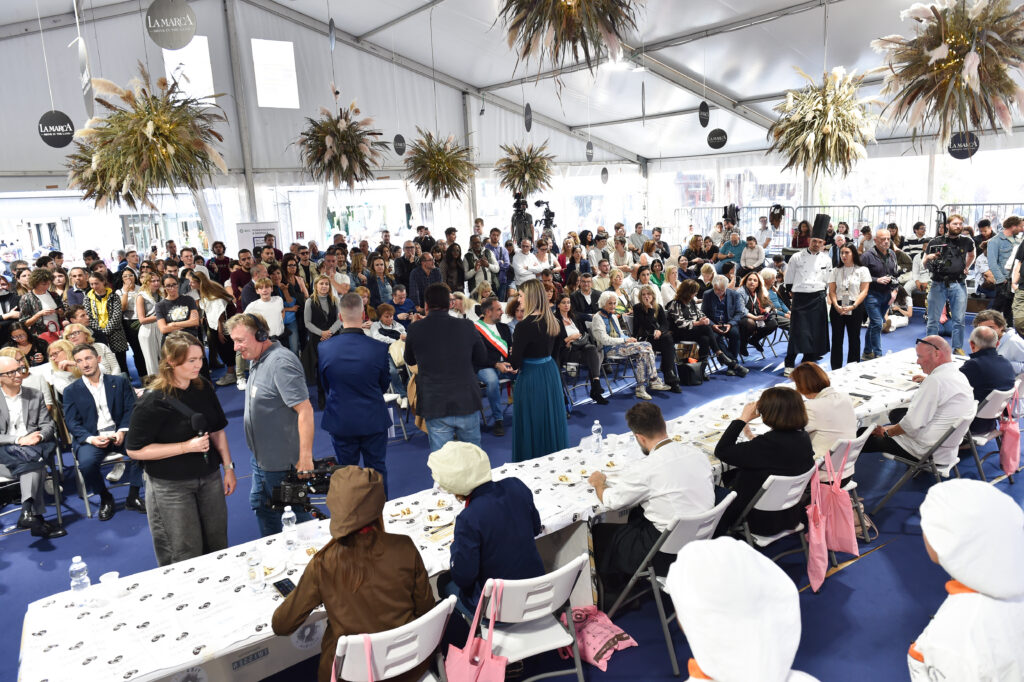
In 2025 applications for the Tiramisù World Cup popular jury lasted just fourteen hours, from ten in the morning until midnight, and anyone who logged on without having studied the rules didn’t make it. Find out how you too can be part of the popular jury at the next edition of the Tiramisù World Cup, taking place in Treviso from 9 to 11 October.
Applications for 2026 aren’t open yet, but there is an official date: the test will be held on the morning of 12 September.
If you don’t want to miss any updates, follow us on our social channels: the link will be announced in our stories and will be available a few hours in advance to anyone who signs up for the dedicated newsletter on the Tiramisù World Cup website.
In the meantime, there’s one essential thing to do, and that’s get ready. Because when the window opens, the selection rewards whoever answers first and whoever answers best.
How the selection works
Who can apply to be a popular judge
The rules are open: anyone over eighteen can apply, from any country in the world. You don’t need to work in catering, you don’t need a pastry qualification, you don’t even need to know how to make tiramisù.
That’s exactly the point of the popular jury: tiramisù was born in people’s homes, and the first verdict belongs to those who make it and eat it with their families, not to those who make it for a living. The semi-finals and the final on 11 October then pass to a jury of professionals — pastry chefs, journalists, food experts — but the first round, the one that decides who moves forward in the competition, is entrusted to ordinary people.
The one substantial requirement is knowing the competition rules and the tiramisù recipe well. That’s precisely what you’re selected on.
How the click day works
The application takes the form of an online test of 15 multiple-choice questions based on the competition rules. The form appears on the official Tiramisù World Cup website on a specific day and at a specific time (the so-called click day) and stays open for a few hours. Outside that window there’s no other way to apply.
For 2026 the organisers haven’t announced the date of the test yet. To stay up to date you can sign up for the official newsletter for judges on the competition website or follow our social channels.
It’s worth taking seriously: in one of the past editions the available judge places ran out in twelve hours.
How the ranking works
This is the mechanism worth understanding properly, because it changes the way you approach the test.
The ranking is built on two combined criteria: the score obtained, from highest to lowest, and the chronological order of submission. Answering well isn’t enough and being quick isn’t enough: you need both. Which is why studying in advance counts double.
Those who pass the selection go into the Register of judges; the others may be listed as Reserve judges and, if they confirm their availability, they follow the same path as those selected. The outcome arrives by email about a week after the test. The Organiser’s decision, the rules state, is final and not open to appeal.
How to prepare for the test
The study material is public and available on the official TWC website: the competition rules and the FAQ. On the same applications page you’ll also find a practice test with 15 sample questions, which doesn’t count towards the selection but faithfully reproduces the kind of questions you’ll face.
Taking it makes one useful thing clear: the questions aren’t just facts to memorise. There are three types.
The first concerns ingredients, equipment and, from this edition, our Territory. These are the most straightforward questions.
The second type tests the difference between the two competition categories, and it’s where people go wrong most often.
The third type is the trickiest, because it doesn’t ask for a rule but for a course of action. What should a judge do who, while tasting, clearly detects an ingredient that isn’t permitted and hasn’t been declared? Which criterion weighs more heavily on a tiramisù that is technically correct but unbalanced in flavour? These are questions about the role, not about the dessert.
What accepting the role involves
The judge’s role is voluntary and unpaid. You pay nothing to take part, but you aren’t paid either, and travel and accommodation costs are yours to cover. If you’re coming from out of town, factor that in when you plan the weekend, and remember that you can get a 10% discount on your stay at the properties taking part in the initiative.
By accepting the role you undertake to follow a number of specific rules, which the regulations set out plainly: attend the orientation briefing, held in Treviso in October and also accessible by webinar; report to the Accreditation Point at least fifteen minutes before your shift starts; behave in a way consistent with the values of the event; judge fairly and impartially; add up the scores on the evaluation sheet correctly; report any conflicts of interest or irregularities to the staff immediately.
How judging works during the competition
The popular jury’s work is concentrated in the Qualifying rounds, on 9 and 10 October in the centre of Treviso. Contestants are divided into groups of no more than ten, and each group has its own dedicated jury. Every popular judge works alongside another judge and a Jury President, an expert figure who acts as the point of reference during the shift.
The competition round lasts forty minutes. When time is up the contestant cuts their tiramisù into at least four portions and the judges taste it straight away: there are no fridges at the stations, and a tiramisù left waiting is no longer the same tiramisù.
Judging is based on five criteria, each scored from 1 to 10:
- Technical execution — how the dessert was prepared
- Visual presentation — how the plate looks
- Intensity of flavour — how recognisable the taste is
- Balance of the plate — the relationship between the ingredients
- Savour and harmony — how the components work together
In the event of a tie, Balance decides, and it’s also the criterion where the difference lies between a tiramisù that is technically correct and one that really works.
Frequently asked questions
Do I need to know how to cook to apply?
No. The requirement is to be over eighteen and to know the competition rules and the tiramisù recipe. The popular jury is designed precisely for people who aren’t professionals.
Can I apply if I don’t live in Italy?
Yes. Applications are open to people over eighteen from any country in the world. The orientation briefing is held in Treviso, but it can also be followed by webinar.
How much does it cost to be a judge?
Nothing, but it isn’t paid either: the role is voluntary and unpaid. Travel and accommodation are at your own expense.
When do applications open for 2026?
The official date is set: the test will be held on the morning of 12 September. The link will be announced in our stories and will be available a few hours in advance to anyone who signs up for the dedicated newsletter on the Tiramisù World Cup website.
If I’m not selected, can I still take part?
Yes, in two ways: as a Reserve judge, if you fall into that category and confirm your availability, or as a spectator. The Qualifying rounds, the semi-finals and the final are all free to watch, and over the three days of the event the centre of Treviso hosts tastings, workshops and talks.The practice test is already online and takes just a few minutes. Try it now on the official Tiramisù World Cup website: if you get a few answers wrong today, you have plenty of time to put it right before the click day.
For the full programme of the tenth edition, the dates and what to do in Treviso during the days of the competition READ THE GUIDE TO TWC2026!